Custom Trade Show Booths in Chicago: How to Brief a Local Builder
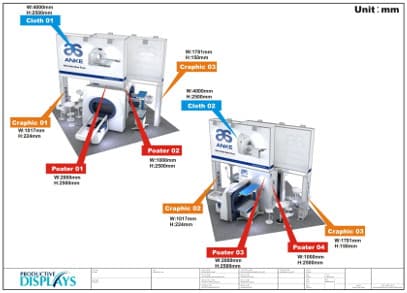
A custom trade show booth is a piece of engineering, not a piece of decoration. It has to fit a specific footprint under a specific ceiling height, in a room with specific rules, and it has to do a specific job on the show floor. The reason most custom booths land underwhelming is that the brief is fuzzy when it goes to the fabricator. Here is how to make it crisp, and what a local builder in the Chicagoland area can actually help you get right.
Know your space before you design it
The booth type determines what you can build. Linear, or inline, booths are open on one side, typically ten feet deep, with a height cap of around eight feet along the back wall and no hanging signage. Peninsula booths are open on three sides, and hanging signage is commonly permitted up to about twenty feet. Island booths are enclosed, and the rules are more permissive but so is the cost in freight and rigging. Our custom exhibits start with your exact space, not a generic template.
Decide the job the booth has to do
Before any drawing, decide what you want a prospect to do in your space. Walk in? Touch a demo? Hand you a lead? Scan a device? Take a sample and walk away? The answer changes the layout, the sightline, and the hardware. A booth that is beautiful but does not give a prospect a reason to slow down is a very expensive sign.
The brief that saves money
- Footprint and booth type. Exact dimensions and the organizer’s spec sheet for height, hanging, and power.
- Message architecture. The one thing you want the booth to say from ten feet away, and the one action you want at the counter.
- Branding. Logo files, brand colors, and any must-appear elements. Vague branding is the number-one rework driver.
- Power and data. How many circuits, what amperage, and whether you need an uplighting package or a hanging sign that requires a rigging permit.
- Freight and timeline. Where the booth ships from and to, and the install and dismantle dates. Late changes to the timeline are expensive at the venue.
What a 3D render gets you
A render is not a nice-to-have; it is a decision tool. It is the first place you catch a sightline error, a color that does not read at distance, a counter that is too shallow, or a logo placed where it will be obscured by a passerby’s shoulder. It is also the way you sell the budget to the people who approve it, because a render is a specific, agreed-upon object rather than a hope. Our booth design service walks this exact sequence, from concept through layout, brand integration, and a final 3D pass.
Working with a local fabricator
A fabricator in the Chicagoland area changes the math on install day. Instead of a crate that crosses the country and you hope arrives intact, the booth is built a short drive from your venue, can be walked through before the show, delivered and installed on-site, and repaired mid-show if a panel tears or a light burns out. For a show at McCormick Place, Navy Pier, or the Donald E. Stephens Convention Center in Rosemont, the logistics compress from a multi-week freight problem to a local delivery and install window. That is what our Chicago shows and venues guide is built around, and the build cost is broken down in our trade show booth cost guide.
If you have a show, a footprint, and a budget, tell us the three and we will send back a render, a plan, and a price that match the floor you are actually walking. Start your booth design.