Modular vs Custom Trade Show Booths: Which Should You Buy?
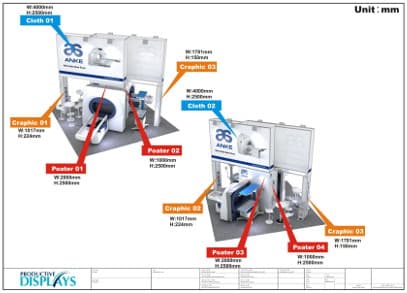
Almost every exhibitor eventually faces the same choice: keep buying modular kits that assemble into a decent booth, or commission a custom build that does exactly what the brand needs and nothing else. Both are legitimate. The expensive mistake is choosing either one for the wrong reason — buying custom because it feels more serious, or staying modular because it feels safer, without checking which one actually fits how you exhibit.
What modular and custom actually mean
Modular means a system of stock components — frames, panels, connectors, counters, light bars — that can be assembled into more than one configuration. You are buying a kit of parts, and the value comes from reusing those parts across different footprints.
Custom means the structure is designed and fabricated for your specific space, brand, and demo requirements. There is no catalogue; there is a drawing set, an engineering review, and a build.
The line is blurrier than the brochures suggest. Most "custom" booths use some stock hardware, and most good modular booths use custom-printed graphics. What actually separates them is who owns the geometry: with modular, the manufacturer does; with custom, you do.
The four questions that decide it
- How many shows a year, and at how many different footprints? If you exhibit at four shows in three different booth sizes, modular usually wins on total cost because one inventory covers all of them. If every show is the same 20x20, that flexibility is worth nothing.
- How often does your message change? Graphics are cheap to reprint; structure is not. If your product line shifts every season, you want a structure that stays and graphics that change — which both approaches can do, but modular makes it routine.
- Does the booth have to do something structural? Integrated product displays, demo stations, second-storey elements, hanging signs, or a shape that has to be seen from four aisles — those are custom problems. Modular kits approximate them; they do not solve them.
- What is your storage and shipping reality? Modular kits collapse into cases and fit a small warehouse. A custom island needs crates, a loading dock, and a plan. If you do not have the space, that is a real constraint, not a detail.
Cost: the honest comparison
Published ranges put a complete, well-lit 10x10 backwall with graphics in the $1,500 to $5,000 band, modular systems that build a 10x10 or a 10x20 in the $5,000 to $20,000 band, and custom fabricated exhibits from roughly $20,000 upward, quoted per project. Our trade show display cost guide breaks those tiers down by what each actually includes.
What the tiers hide is the second purchase. A modular kit bought at 10x10 can grow to 10x20 by adding parts. A custom 10x10 usually cannot — you commission again. Over five years and eight shows, that difference frequently outweighs the sticker price, which is why the "custom is more expensive" assumption is only true for the first invoice.
Where modular wins
- Multiple footprints. The same kit builds a 10x10, a 10x20, and a 20x20 with the right add-ons — see our modular booth systems.
- Repeatable installs. Numbered parts and a fixed assembly sequence mean a different crew can build the same booth correctly.
- Lower freight and storage. Collapsible frames and wheeled cases reduce both.
- Faster replacement. A damaged connector is a part number, not a fabrication job.
- Test before committing. You can rent a modular kit first and see how the footprint behaves before buying.
Where custom wins
- Differentiation is the goal. At a show where everyone has a 20-foot backwall, a shape nobody else has is the whole point.
- The booth is a sales channel. Meeting rooms, demo bays, product plinths, integrated AV, and storage that disappears are design problems, not component problems.
- Structural requirements. Hanging signs, two-storey elements, and rigging loads need engineering that stock kits do not carry.
- Brand systems. If your retail environments, packaging, and booth all have to read as one thing, the geometry usually has to be bespoke.
Our custom exhibit work covers the range from 10x10 to 20x20 islands, including the projects where a modular kit genuinely would not have worked.
The hybrid most people should consider
The most common outcome for a mid-size exhibitor is not a pure choice. It is a modular structure chosen for its geometry, dressed with fully custom graphics, lighting, and one bespoke element — a reception counter, a product wall, a hanging sign. You get a booth that reads as custom on the floor and still collapses into cases at the end of the show.
That approach also keeps the reprint budget sane: the structure is a one-time purchase, and the graphics are the part that changes with the message.
Timeline differences
Modular usually ships from stock or configures in two to four weeks including graphics. Custom needs design time, then fabrication: plan on eight to twelve weeks from brief to ship, longer if engineering or a hanging sign is involved. If your show is in five weeks, that decision has effectively already been made for you. The custom booth brief guide explains what a build needs before design can start.
The Chicago angle
At McCormick Place and the Stephens Convention Center, the practical differences show up on move-in day: drayage weight, crate count, labor hours, and how quickly a problem can be fixed. A modular kit is usually cheaper to move and faster to correct. A local fabricator can also stage and repair a custom build without waiting on freight — worth reading the venue and planning guide before you commit to either.
A short decision rule
If you exhibit more than three times a year at more than one footprint, start modular and spend your custom budget on graphics and one signature element. If your booth is a primary sales channel, has to be structurally different, or carries product demos that need real estate, go custom and plan the timeline properly. If you are not sure, rent first — a single show in a rented kit answers more questions than another round of renderings.
Tell us your show calendar and footprints and we will tell you which path the arithmetic actually supports.